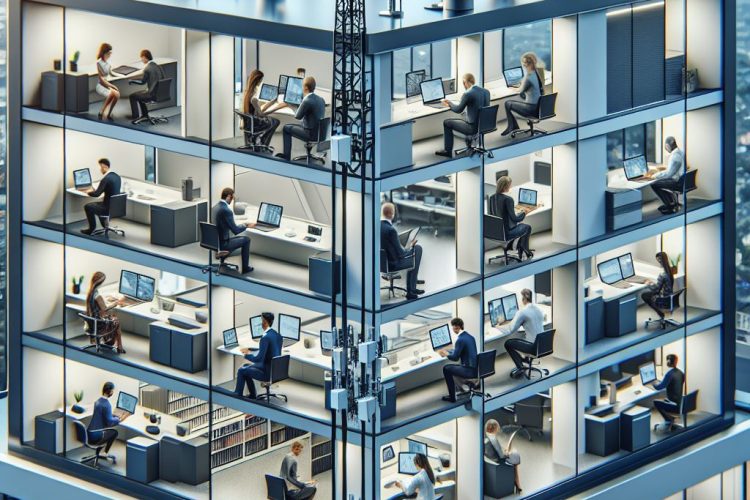
The Hidden Cost of Insulation: Why Energy-Efficient Glass Kills Corporate 5G Signal.
Have you ever wondered why your phone showcases full 5G reception just outside your corporate building in Kirchberg or Cloche d’Or, but drops down to an unusable 3G or a total dead zone the moment you walk past the reception desk?
You are not alone. As corporate spaces across the Grand Duchy push to meet stricter European green energy guidelines, poor indoor mobile signal has become a silent epidemic in modern commercial real estate.
The culprit isn’t your telecom provider. It is your highly advanced, energy-efficient windows. The Core Technical Culprit: Low-E Glass as a Faraday Cage.
This issue is accelerated by the evolution of mobile networks. Older voice services relied on highly penetrative low frequencies. Modern high-speed 5G signals deploy heavily on higher mid-band spectrums like 1800 MHz and 3.6 GHz to deliver massive data capacity. Because these higher frequency radio waves are significantly shorter, they lack the energy required to penetrate dense architectural elements or metallic films.
Modern commercial real estate relies on low-emissivity (Low-E) double or triple-glazed window panes. To drastically lower heating and cooling bills, glass manufacturers apply a microscopic, transparent layer of metal oxides directly onto the glass surface.
- The Benefit: This metal layer successfully reflects infrared radiation heat away during summer and keeps indoor warmth trapped during winter.
- The Issue: This dense atomic metal coating acts as an accidental radio frequency shield.
Because high-frequency 4G and 5G signals rely on smaller, tighter radio waves, they lack the energy to penetrate this metallic film. Your premium, eco-friendly office envelope essentially transforms into a Faraday cage, deflecting vital cellular signals from local operators right back into the street.
The Traditional Dilemma: Active DAS vs. Building Performance
Historically, facility managers trying to resolve an indoor mobile signal problem had to install complex active Distributed Antenna Systems (DAS) or high-power electronic signal boosters.
While active options work, they create massive logistical friction:
- They consume a continuous 24/7 electricity supply.
- They demand complicated multi-operator carrier agreements and licensing.
- They require extensive drilling, heavy copper cabling, and visible antennas throughout the interior walls.
Fortunately, network engineering has evolved away from bolting on heavy hardware. Instead, ITNET solves the connectivity problem directly at its source: the building’s architectural skin.
Enter WAVETHRU: Opening the Glass Envelope Intelligently
Instead of fighting the glass, ITNET alters how the windows interact with radio spectrum frequencies. By applying the WAVETHRU precision laser surface treatment directly onto existing glass panes, we open up targeted cellular pathways.
Certified field engineers operate localized, specialized laser machinery right inside your active office spaces. The laser carves an incredibly fine, microscopic mesh pattern right into the existing Low-E metal coating. This completely removes the Faraday cage bottleneck, letting all cellular bands under 6GHz—including modern 5G and emergency frequencies—pass inside entirely unobstructed.
You can read a complete overview of this technology on our primary page about how to improve indoor mobile coverage.
Addressing Your Top Tech & Legal Concerns
1. Does This Laser Treatment Void Window Manufacturer Warranties?
No. Because the WAVETHRU laser etching process is incredibly gentle and highly targeted, it interacts exclusively with the microscopic metal coating layer without structural impact. The physical integrity, tempering, and laminated safety profiles of your glass panes remain completely untouched. ITNET provides fully certified implementations that maintain standard asset compliance.
2. Does It Degrade the Window’s Thermal Insulation (U-Value)?
Absolutely not. The 30µm laser-engraved lines are essentially invisible to the human eye and leave the structural, optical, and thermal properties of the glazing fully intact. Your building retains its original insulation values (U-value), solar heat gain coefficients, and energy ratings. You regain cellular freedom without losing an ounce of thermal efficiency.
3. Is It Future-Proof for Upcoming Network Changes?
Yes. Because WAVETHRU is an entirely passive solution, it contains no electronic hardware that will eventually grow outdated or face breakdown. It is natively multi-frequency and perfectly compatible with all future network upgrades.
Let Audit Your Building’s Connectivity
If you are currently experiencing poor voice quality, dropped video feeds, or failed multi-factor authentication SMS codes within your Luxembourg premises, let our team run an initial on-site radio frequency diagnostic.
Ready to map your signal gaps? Reach out directly via email Info
Prefer a call back? Drop your details directly into our contact form at contact, and an expert will coordinate your baseline connectivity scan.